Hard Water, Clean Paint: The 2026 Rinse Setup That Beats UK Mineral Spots

Photo: car final rinse with deionised water filter hose on UK driveway, via wallpapercave.com
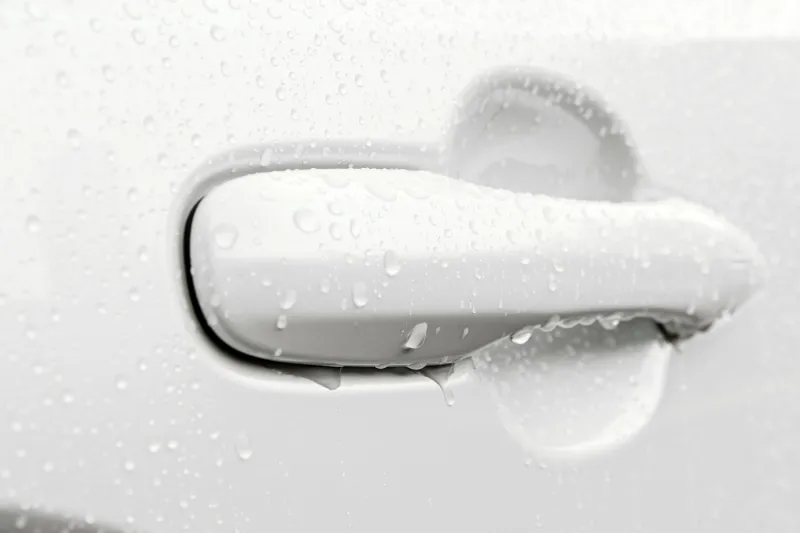
Hard water is one of those quiet UK paint killers. You can spend an hour washing carefully, then ruin the finish in the final rinse because the tap water in your postcode is loaded with calcium and magnesium. The result is a car covered in pale, crusty dots that look harmless until the sun hits them and you realise they have started to etch the clearcoat.
Why hard water leaves more than a chalky kettle
When water droplets sit on paint and evaporate, whatever was dissolved in them stays behind. In soft-water areas that might be a faint smear. In hard-water areas—much of London, the South East, East Anglia, and parts of the Midlands—it can be a concentrated mineral deposit. Leave those deposits on a warm bonnet and they can bond to the clearcoat. Wash them off quickly and you are fine. Leave them for a few sunny days and you may need a machine polish to remove the ring marks.
That is the frustrating part: the damage often happens after the wash, not during it. A spot-free rinse is not a luxury extra. It is the difference between a car that looks sharp and one that looks like it has been parked near a sprinkler.
Test first, buy second
Before you spend £200 on a filtration setup, spend £15 on a TDS pen. TDS stands for total dissolved solids. It is not a perfect hardness test, but it gives you a useful number. Fill a clean glass with tap water, let it reach room temperature, and dip the pen. If your reading is around 50–100 ppm, you may get away with a basic inline filter for final rinses. If it is 250–400 ppm, you will burn through resin quickly and should look at a refillable DI vessel or reverse osmosis.
You can also check your water supplier’s hardness map—Thames Water, Severn Trent, Yorkshire Water and others publish postcode data—or look at your kettle. Heavy scale is a clue. None of this is lab-grade science, but it stops you buying the wrong kit.
The rinse options, honestly compared
Inline resin filter. These fit between your tap and hose and remove hardness minerals as water passes through. They are convenient and cheap to start with, but capacity is limited. Use them for the final rinse only, not the whole wash, or you will exhaust the resin in a few sessions.
DI vessel. A larger refillable cylinder filled with resin. Better value if you wash often, and you can recharge or replace the resin when the output TDS climbs. It takes up space, but it is the practical choice for hard-water areas.
Reverse osmosis. Excellent water quality, but higher upfront cost and waste water. Worth it if you are serious about spot-free drying and wash regularly.
Carbon filters. Great for chlorine and taste, useless for hardness. They will not stop mineral spots.
Rainwater. Soft, but it can carry grit and organic matter. Fine for a pre-rinse if filtered, not for a final rinse on clean paint.
If you have no outside tap, you can still play. A 5-litre pump sprayer filled with deionised water makes a credible final rinse on a single car. Use it top-down, keep the nozzle moving, and don’t flood the panels.
Drying technique matters as much as water quality
Even perfect water can leave spots if you let it dry in the sun. Work in shade or early morning. Use a plush microfibre drying towel, lay it flat and pat rather than scrub. A blower is excellent for mirrors, grilles and panel gaps. If you are using tap water, dry one panel at a time and keep the towel moving. A drying aid—a spray sealant or dedicated drying lubricant—adds a little slip and helps pick up remaining droplets.
Do not use a chamois. They are harsh, they trap grit, and they drag. Do not let droplets bake on a warm panel while you answer your phone. That is how spots become stains.
A realistic Sunday-morning routine without a garage
Street parking does not mean you need a full filtration lab. Here is a workable routine for a UK driver with no driveway.
- Check the TDS of your tap water. If it is high, buy a small DI vessel or an inline filter.
- Wash with a pH-neutral shampoo and two buckets if you can. Keep the car wet and work out of direct sun.
- For the final rinse, switch to filtered or deionised water. If you have no hose, use a pump sprayer.
- Dry immediately with a clean microfibre towel, starting at the roof and working down.
- Keep a second towel for the lower panels. Swap before it gets soaked.
- Clean your towels properly—no fabric softener, no gritty wash—and store them dry.
That is it. No magic, no ten-step ritual. The aim is to remove the minerals before they dry and to dry the paint before anything else lands on it. In a hard-water postcode, that final rinse is the part that protects the finish. Get it right and your Sunday wash will stop being a slow way to add spots to your paint.